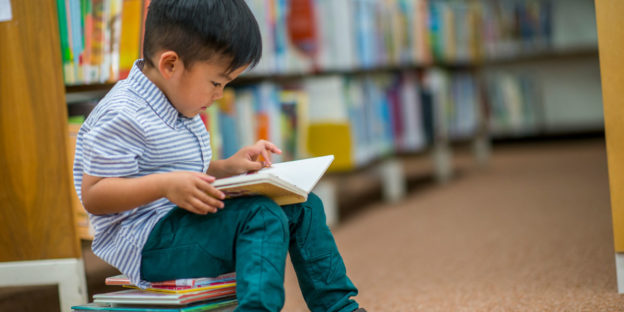
“Once you learn to read, you will be forever free.” – Frederick Douglass
How Preschool Teachers Do It

written by Alison Kentos & Cindy Terebush

1: Modeling Literacy Skills for Young Children
My daughter, Cynthia, has done an incredible job weaving joy into reading with my grandsons, Max, Arlo, and Barrett. Recently, I stayed with the boys while Cynthia and her husband, Sam, attended a friend’s wedding. Cynthia provided an update on the current bedtime routine now that Barrett was approaching two years old. At a certain point in the evening, all of the boys enjoy choosing books to read before bed. I usually allow each of them to pick two or three books and then read each to them before putting Barrett to bed. The plan was to read the books in the older boys’ room. On this particular night, the boys chose their books while I disposed of Barrett’s diaper. I went to Max and Arlo’s room to start reading, but the room was empty. I could hear giggles down the hall. I walked into Cynthia and Sam’s room to find two boys on the bed with a large pile of books and in comes Barrett with another stack of books from his room. I joined Max and Arlo and watched as Barrett continued to bring a lot of the books from his room to his mama and papa’s bed. He was very proud of his accomplishment and, when finished, he climbed on the bed and snuggled up next to me to start reading the books. I read all of the books at least once. There were about thirty books stacked and scattered on the bed. All the boys listened as I read each story. It was so fun!
Max, Arlo, & perhaps Barrett will remember that event for the rest of their lives. Moments such as this can be so pivotal in a child’s mind. It sets the foundation for their attachments to reading and storytelling. This appreciation of storytelling is what compels author Robyn Weible to create and read to her grandchildren.
I, Grace, feel that one of my fondest memories from childhood is sitting in my mother’s lap, listening to her read and watching her finger point to each word in a book. The sound of her calloused finger dragging across the page as she phonetically enunciated the words, ‘jah-a-k a-n-d ji-ll wah-en-t uh-p th-e h-i-ll’ enchanted me.
The letters swam around the page, registering as symbols in a code to crack in order to form a beautiful lyric. The cadence of her voice as she used different accents and inflections based on the character or mood of the scene rang in my head. All of these pieces came together in an orchestral formation inviting me to a mindful cinematic experience. I could feel myself hop inside of a story and play along with the characters. I always wanted just one more story. I felt free in her arms. She pointed to the pictures in the books and asked me questions about how I felt about the scenes and the character’s actions. I liked being trusted with the questions. I felt empowered as I answered, “I don’t think it was very nice of Jack to push Jill on the playground.” I felt such joy when she affirmed my assessment.
Literacy and the lack thereof has an incredible history. The ability to read is a key to freedom. It is a crucial tool that helps each and every one of us navigate our way through life. Think of a time you were lost in a foreign city, taken the wrong train on the subway, or broken down on the side of a road. Because you can read, you were able to navigate a map, find proper directions, and read an owner’s manual. We are able to handle life’s little mishaps because we are able to read our way to solutions. At the very least, we can read signs that direct us to information desks & numbers to call when all else fails.
Waves of gratitude crash over the mind upon realizing all the beauty and knowledge gained from having the ability to read: sounding out the word em·pa·na·da at a Mexican cantina. Soaking in the poem on a wedding invitation. Deciphering the directions for building a baby crib. Interpreting graffiti on a bridge. Passing the driver’s test at the DMV. Mastering grandmother’s prized recipe for the holiday office party. Trying to remember book titles as you parooze a friend’s personal library.
We owe it to the caretakers and teachers who patiently taught us how to read. It is a privilege to have resources and adults willing to teach. This is a privilege that not everyone has access to. In The Literacy Crisis Jeff McQuillan states,”Children in low-income families lack essential one-on-one reading time. The average child growing up in a middle class family has been exposed to 1,000 to 1,700 hours of one-on-one picture book reading. The average child growing up in a low-income family, in contrast, has only been exposed to 25 hours of one-on-one reading (McQuillan, 1998).” This one-on-one interaction is extremely important. Early childhood development has a crucial role in setting the stage for the future self. According to America’s Early Childhood Literacy Gap, a report published by Jumpstart in 2009,
There is an overwhelming academic consensus that the earliest years of life, from birth to age 5, is the time when a child’s brain is undergoing the most growth and development.^1
Cognitive development is the product of two interacting influences – brain growth and experience – both of which exert their greatest impact during the first five years of life. The developing brain triples in the first year alone and is virtually fully formed by the time a child enters kindergarten.^2 This period is critical and sets the stage for all of later learning and adult functioning.
Reading to a child during this critical time, specifically during the preschool years of ages 3 – 5, builds a number of skills that are key to literacy, including phonological awareness, alphabetic knowledge, and concepts about print conventions.^3
Research Connections published a report in 2005 stating, “The greatest amount of brain growth occurs between birth and age five. In fact, by age 3, roughly 85% of the brain’s core structure is formed. In contrast, the majority of our investments are made in the traditional education years of K-12, which begin at age five.” The evidence is mounting. Early childhood development is the most foundational part of a child’s life. It is important to communicate and read with children well before they can speak and read. The very act of reading and talking familiarizes in their minds and sets the stage for future learning and cognition.
A newborn’s brain capacity for growth and knowledge is almost unbelievable. Our babies and toddlers are so capable! The sound of a human voice, the sight of letters and pictures in a book, the feel of the pages and the weight of a book all affect the way a child learns to process material. They can learn this at a very young age. Their attention spans are short. It is okay if you cannot get through an entire picture book in one sitting. What is important is that you read to them for whatever length of time the child is willing to focus on a book. If you can only make it through five minutes, then that’s five more minutes your child is exposed to a book.
Playing audio books in the car during road trips can be an equally opportune adventure as well. Listening to music sung in a different language can help heaps! Exposing children to multiple languages when they are little can make it much easier for them to process and learn other languages when they are older. The US Department of Education states in a report that children will benefit academically from hearing and learning multiple languages because switching between languages helps them develop a flexible approach to problem solving. “The ability to read and think in two (or more) different languages promotes higher levels of abstract thought, which is important in learning.” Children’s ability to learn has no bounds!
The following video is John Trischitti’s story of literacy and the importance of forming connections to reading and storytelling. Beyond this video is a list of material to read and watch in order to investigate the true weight of illiteracy in this country and the world.
We encourage caregivers to read and play with their children as soon as possible. We also encourage helping our neighbors that might not have the same resources to provide for their children. Love Letters for Literacy is a wonderful organization that provides pre-readers from lower income neighborhoods with packets of handmade letters that make it easier for families to teach literacy while playing games and having fun. “Love Letters packets engages families to make learning letters into a game. Each child also gets to select a bag of books to take home to keep! Love Letters promotes literacy while encouraging a lifelong love of reading!” If you want to get involved please email loveletters.literacy@yahoo.com.
-Grace Pavlovec & Robyn Weible
Works Cited & Additional Resources
A Literate Life | Bridget Shingleton | TEDxDayton
A simple idea to eradicate illiteracy | Beth Wilder | TEDxYouth@MBJH
America’s Early Childhood Literacy Gap. Jumpstart, 2009, http://www.craftinc.org/literacy-e-books/americas-early-childhood-literacy-gap.pdf.
“Benefits of Multiple Languages for Children.” GrapeSEED, 11 Sept. 2017, https://grapeseedus.com/big-benefits-of-multiple-language-learning-for-children/.
Fifty Top Literary Statistics. Ferst Readers. https://ferstreaders.org/resources/fifty-top-literacy-statistics.
First Things First Blog / Podcast: Reading, Language and Early Literacy
Kentos, Alison. Terebush, Cindy. How Preschool Teachers Do It 1: Modeling Literacy Skills for Young Children
The Life of Frederick Douglass
Literacy is the Answer | John Trischitti | TEDxACU
McQuillan, J. (1998).The Literacy Crisis: False Claims, Real Solutions. Heinemann.
Schweinhart, Lawrence J. Montie, Jeanne. Xiang, Zongping. Barnett, W. Steven. Belfield, Clive R. Nores, Milagros. Lifetime Effects: The High/Scope Perry Preschool Study through Age 40, 2005, https://www.researchconnections.org/childcare/resources/7622.