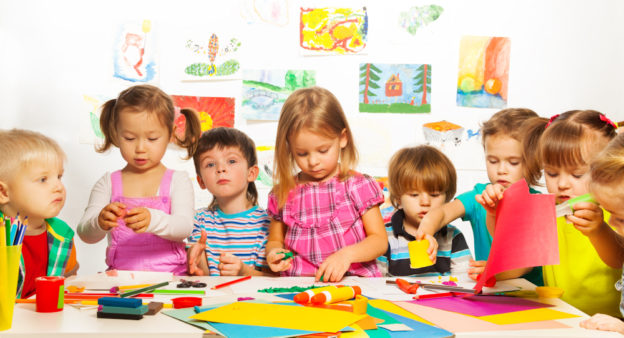
“Art can permeate the very deepest part of us, where no words exist.” – Eileen Miller
Art therapy, or forms of it, have existed since the dawn of man. The oldest piece of known art dates back to 700,000 BC found in two ancient quartzite caves in the Madhya Pradesh region of central India. Humans utilize art to communicate emotion beyond language rendering the expression and interpretation of art available to anyone. Art is the all-encompassing tool that every single person can use in order to navigate experience and feeling. Children are specifically susceptible to artful expression because they are uninhibited by language and indoctrination. Thus art therapy is a reliable medium for healing children.
Children want to be acknowledged and feel heard more than anything else. They will seek attention and boundaries if their emotional needs are not met. The creation and acceptance of art can be a constructive interface between the child and the caregiver. This form of communication can be therapeutic. One can facilitate this interchange by encouraging children to illustrate or create how they feel about certain situations through drawing pictures or painting. A caregiver can seek a licensed art therapist if they find it difficult to independently utilize art to communicate expression with a child.
Many adults understand expression through art as naturally therapeutic. The rise of adult coloring books hit an all time high in 2016 because people found solace and mediation in coloring intricate flowers and mandalas for hours. The “Sips & Splatters” business model has taken off because adults find happiness in having a glass of wine while learning painting techniques with their friends. Author Robyn Weible created Netsil’s Journey to Planet Nybor as a way to express her inner imagination with her grandchildren & this process has brought such joy to her life. The approach to art as therapy has numerous paths. The most formal definition of art therapy is as follows:
The American Art Therapy Association states art therapy is a mental health profession in which clients, facilitated by the art therapist, use art media, the creative process, and the resulting artwork to explore their feelings, reconcile emotional conflicts, foster self-awareness, manage behavior and addictions, develop social skills, improve reality orientation, reduce anxiety, and increase self-esteem. A goal in art therapy is to improve or restore a client’s functioning and his or her sense of personal well-being. Art therapy practice requires knowledge of visual art (drawing, painting, sculpture, and other art forms) and the creative process, as well as of human development, psychological, and counseling theories and techniques.
Anyone can benefit from informal therapy through art and/or facilitated art therapy. The act of viewing art has equally therapeutic benefits. Studying children’s art has been a pleasure of mine. I happily stumbled upon Illinois State University Milner Library’s International Collection of Child Art. The following are a few paintings from their collection that made my heart smile:
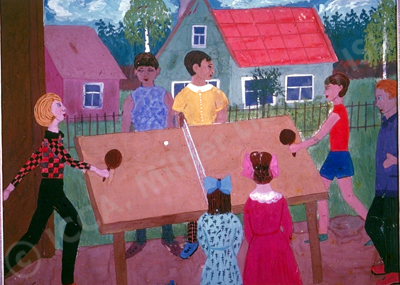
A Tennis Game, girl, age 12, Russia
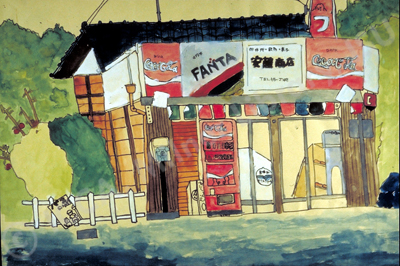
Store Near School , boy, age 10, Japan

Bakeshop, boy, age 12, Mexico

Heading South, boy, age 9, United States
How lovely is the child’s imagination! The art children choose to create reveals their innermost thoughts and happiness as well as anxieties and stress. It can be useful to create a routine of creation with the children in your life in order to mentally track their feelings. Creating art is similar to journaling in this way. We can read a book or two and then ask the children to illustrate how the story made them feel. Similarly, we can discuss their day and ask them to draw how the day’s events went and what feelings they experienced. Gateway to Mental Health Services states the benefits of art therapy as follows:
- Self-discovery: Creating art can help you acknowledge and recognize feelings that have been lurking in your subconscious.
- Self-esteem: The process will give you a feeling of self-accomplishment which can be very valuable to improve your self-appreciation and confidence.
- Emotional release: The greatest benefit of art therapy is giving you a healthy outlet for expressing and letting go all your feelings and fears. Complex emotions such as sadness or anger sometimes cannot be expressed with words. When you are unable to express yourself, but you desire emotional release, making art may help you to do it.
- Stress relief: Fighting anxiety, depression or emotional trauma can be very stressful for you both mentally and physically. Creating art can be used to relieve stress and relax your mind and body.
Robyn found communicating through art to be very helpful when raising her eldest daughter, Cynthia. Each drew or scribbled something in a shared drawing pad if either needed help. They drew black scribbles over entire pages if they were angry. Cynthia would draw a scene from the playground in which an incident occurred that hurt her feelings as she described the events to her mother. Robyn found this form of communication valuable and is happy to see Cynthia practicing different forms of art with her own children.
Let us explore art and the creation of art with the children in our lives to reveal authentic, vulnerable expression within our children as well as in our adult hearts. These sessions can be as lighthearted or extensive as deemed necessary. Sometimes kids just want to paint a few dots and say they are happy in order to run off to the next activity. Other times, they may want to explain their creation thoroughly and vividly. Allot plenty of time for potential revelations. Above all else, enjoy the precious time spent with the little ones we love so much. They can teach us just as much as we hope to teach them.
– Grace Pavlovec & Robyn Weible
Opening up expressive communication with children can sometimes make us feel a little too vulnerable. The following video is an exercise to practice independently before embarking upon therapeutic art sessions with the children in your life. It will hopefully ease personal anxiety and inspire a fresh perspective to introduce to the kiddos when you are ready.
Art for Anxiety | Self Art Therapy Session
Works Cited & Additional Material
Adhikari, Saugat, et al. “Top 10 Oldest Art Ever Discovered.” Ancient History Lists, 25 Mar. 2019, https://www.ancienthistorylists.com/pre-history/top-10-oldest-art-ever-discovered/.
Art for Anxiety | Self Art Therapy Session
Author, Guest. “Creativity and Recovery: The Mental Health Benefits of Art Therapy.” Resources To Recover : Gateway to Mental Health Services , 10 July 2018, https://www.rtor.org/2018/07/10/benefits-of-art-therapy/.
Ha, Thu-Huong. “The Explosive Rise of Adult Coloring Books, Charted.” Quartz, Quartz, 11 Mar. 2016, https://qz.com/637238/the-explosive-rise-of-adult-coloring-books-charted/.
“The International Collection of Child Art at Milner Library.” Milner Library, https://library.illinoisstate.edu/icca/.
Store Near School , boy, age 10, Japan
Uttley, Lesley. “Clinical Effectiveness of Art Therapy: Quantitative Systematic Review.” Systematic Review and Economic Modelling of the Clinical Effectiveness and Cost-Effectiveness of Art Therapy among People with Non-Psychotic Mental Health Disorders., U.S. National Library of Medicine, https://www.ncbi.nlm.nih.gov/books/NBK279641/.